
If you’ve just had your home exterior painted — or you’re planning to — "how long will this last?" is the most natural question in the world. Exterior painting is a significant investment, typically ranging from $2,400 to $7,500+ for a single-family home in the Seattle and Bellevue area. You want to know what you’re getting for that money.
The honest answer depends on more variables than most painting contractors will tell you. Here’s the full picture, straight from a licensed Western Washington contractor who has painted hundreds of homes across King and Snohomish County.
The Real Timeline: What to Expect in Western Washington
With quality materials and proper preparation, exterior paint on a Western Washington home should last 7 to 10 years. Some homes with optimal conditions — protected soffits, good sun exposure for drying, premium coatings, and thorough prep — will go 10 to 12 years. Budget paint jobs with minimal prep in high-exposure conditions may start showing failure in 3 to 4 years.
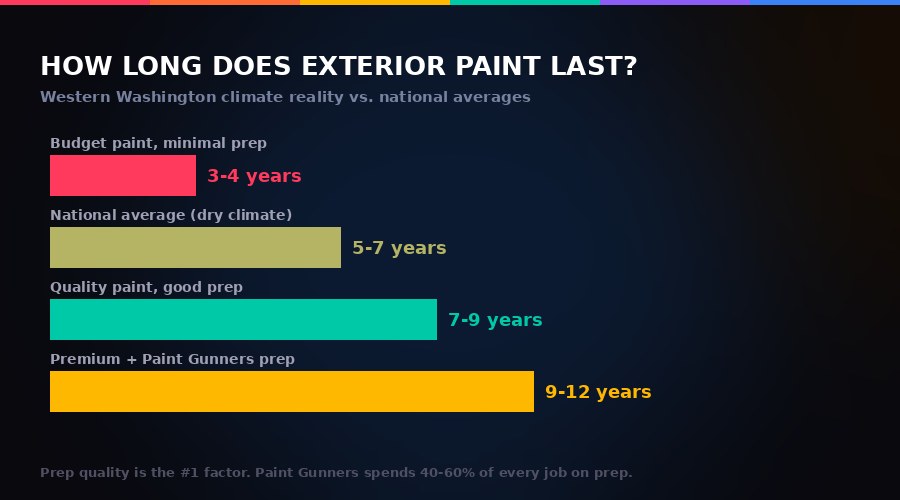
That’s a wide range. Here’s what determines where your home falls on that spectrum.
The Pacific Northwest Climate: Why It’s Harder on Paint Than Most Places
Western Washington presents a uniquely challenging environment for exterior coatings. The Seattle area averages 38 to 40 inches of annual rainfall — more than Miami — distributed across roughly 150 to 160 rainy days per year. But it’s not just the rain. It’s the combination of conditions that makes our climate so demanding.
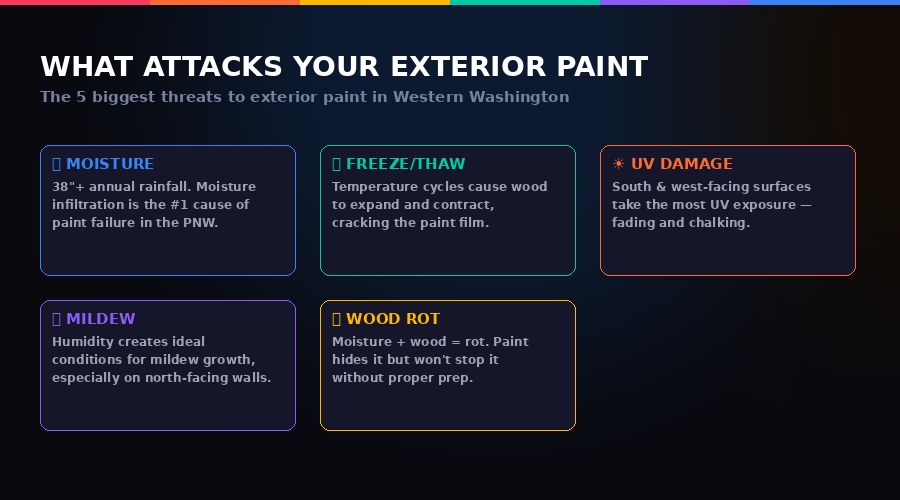
Moisture cycling is the primary threat. Wood expands when wet and contracts when dry, and this constant movement stresses the paint film. Every cycle creates micro-fractures. Over time, those fractures allow water infiltration, leading to peeling, bubbling, and eventually rot.
Freeze-thaw cycles compound the damage. While Western Washington doesn’t experience the brutal winters of the Midwest or Northeast, we do see enough freezing temperatures that paint needs to be flexible enough to handle expansion and contraction without cracking.
UV exposure on south and west-facing walls can be intense during our drier summer months. UV degrades paint binders over time, causing chalking and fading. Quality paint with UV-resistant pigments significantly extends lifespan on exposed surfaces.
Mildew and algae thrive in our moist, temperate climate. They’re not just cosmetic issues — mildew penetrates the paint film and accelerates degradation. Premium exterior paints with mildewcide additives are essential in Western Washington, not optional.
Wood rot is the consequence of moisture infiltration that’s gone too long unchecked. Paint covers but doesn’t cure rot — once wood is compromised, it needs to be replaced before painting.
The #1 Factor in Longevity: Preparation Quality
This is the truth that distinguishes experienced contractors from fast-and-cheap operators: preparation quality has more impact on how long your paint lasts than the paint brand.
You can apply the most expensive Sherwin-Williams or Benjamin Moore product on the market, and it will fail in three to four years if the surface underneath wasn’t properly cleaned, repaired, primed, and caulked.
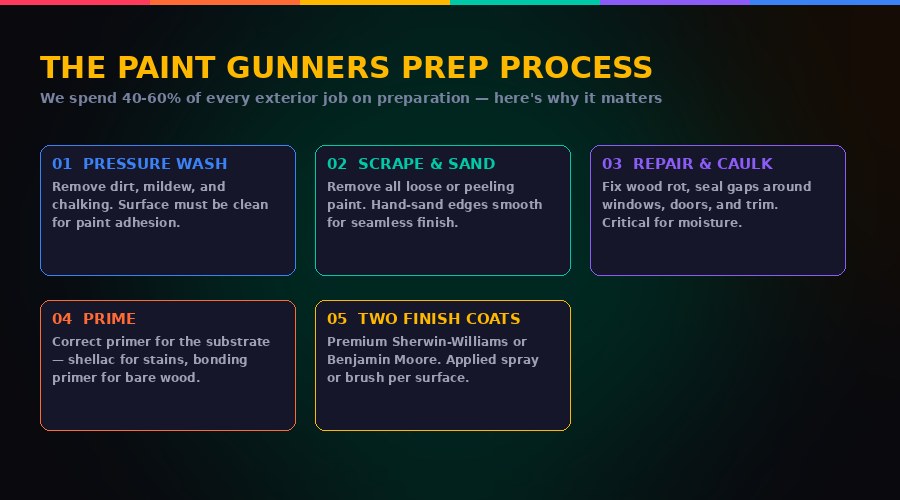
At Paint Gunners, we spend 40 to 60 percent of every exterior project on preparation. Here’s what that looks like:
Pressure washing — All surfaces are thoroughly pressure washed to remove dirt, mildew, chalking, and loose paint. This is not optional and cannot be replaced by wiping down with a rag.
Scraping and sanding — Any remaining loose or peeling paint is hand-scraped and sanded smooth. We sand the edges of remaining paint to feather transitions.
Wood rot assessment and repair — Every surface is inspected for soft spots, rot, and structural compromise. Rotted wood is removed and replaced or treated with epoxy wood hardener before painting.
Caulking — Every seam, gap, crack, and joint around windows, doors, trim, and any penetration through the building envelope gets fresh caulk. Water infiltration through failed caulk joints is responsible for a large percentage of premature paint failures.
Priming — Bare wood always gets primer. Stained surfaces may get shellac-based primer. Skipping primer is another common cause of early failure.
Paint Quality: What Makes a Difference
100% acrylic latex is the standard for quality exterior paint. It remains flexible through temperature cycling, breathes to allow moisture to escape, and resists mildew better than oil-based alternatives.
Mildewcide additives are essential in the Pacific Northwest. All the premium lines we use — Sherwin-Williams Duration and Emerald Exterior, Benjamin Moore Aura and Regal Select — include mildewcide. Lower-end products often don’t.
The premium exterior paints we use run $75 to $100 per gallon at contractor pricing. A budget job often uses $25 to $40 per gallon product. Given that the premium paint may last three to five additional years, the math strongly favors the upgrade.
Signs Your Exterior Paint Is Nearing End of Life
Chalking — Rub your hand across a painted surface. If you get white powder on your palm, the paint binder has broken down from UV exposure.
Fading — Significant color fading, especially on south and west elevations, indicates UV degradation.
Cracking or alligatoring — Paint that shows small cracks has lost its flexibility and is no longer moving with the substrate.
Peeling or bubbling — This indicates moisture is trapped beneath the paint film. This requires attention quickly.
Failed caulk — Caulk that is cracked, missing, or pulling away is an active water infiltration point.
How to Maximize the Life of Your Exterior Paint
Keep gutters clean and properly directed away from the house. Trim back any vegetation that’s in contact with painted surfaces. Wash the exterior of your home annually. Address small issues immediately — a small area of peeling paint that you caulk, prime, and touch up can prevent that area from becoming a large, expensive repair.
Getting an Accurate Timeline for Your Specific Home
The factors that determine longevity are unique to your home. The only reliable way to know what to expect is to have a licensed contractor assess your home in person.
Paint Gunners provides free, detailed written estimates for all exterior painting projects throughout Western Washington. We assess every surface condition, identify any underlying issues, specify exactly what prep work is needed, and recommend the right products for your home’s specific conditions.
Schedule your free exterior painting estimate today. We serve Seattle, Bellevue, Kirkland, Redmond, Bothell, Lynnwood, Everett, and all of Western Washington.